.jpg (1).jpg)

 Search
In a matter of months, the coronavirus pandemic has affected countries worldwide, with cities and businesses being brought to a virtual standstill as critical sectors like waste management worked round the clock to ensure a healthy and safe environment for all. In a webinar organised by Waste & Recycling Middle East and Africa, and moderated by Swaliha Shanavas, industry experts from the region examined the major initiatives, key concerns and strategies adopted by various entities to combat the coronavirus pandemic.
The first in an exclusive series of webinars by the trade magazine brought together industry experts from the region who discussed the significant campaigns and enhanced outdoor cleaning and disinfection techniques implemented till May, key challenges as well as strategies adopted by both government and private entities as part of their efforts to combat covid-19.
 “As part of Dubai Municipality’s efforts to combat Covid-19 when this issue started, we responded slightly earlier than others so we could ensure that we had a plan in place quickly,” said Dr. Naseem Rafee, Director of Health & Safety Department, and Head of Crisis Committee (covid-19), Dubai Municipality. Though they did not have the sterilisation programme at Dubai Municipality (DM) earlier, she said they were able to implement these services within a week, “because we have the expertise as we are already assessing and ensuring that these consumer products including sanitisation solutions comply with all the specifications set by DM.” So, besides approving the companies that are providing cleaning and disinfection services, sanitisation tunnels and products used for these processes, the Municipality also started their own programme for sanitising outdoor areas.
DM has a number of roles and responsibilities and one of their strategic objectives is to ensure public health and safety. “So, we made everything available for the national sanitisation programme. We had prepared our team early and Dubai is the leader in this programme, having started the sterilisation campaign a couple of weeks earlier than the national programme,” said Dr. Naseem. DM covered many areas in the emirate at the time and later joined the national campaign when it started on March 25. The focus has been on all public areas, public facilities, streets, parks, malls and public transportation, all in line with the country’s precautionary measures for the prevention of the Covid-19 and WHO recommendations.
DM has covered all 226 areas in Dubai and since they had started early, they could also repeat the process in these areas to cover 458 areas overall, the director noted. “In the repetition period, we focused on sanitising daily, areas with high population density, high-risk areas like metro stations, etc. Since the programme started, we have been documenting the process and the disinfectants used, including the quantity and type of products,” she said.
 Since the outbreak in Wuhan, they closely followed the developments and tried to gather information from around the world including WHO and the local authorities to understand the measures required, said Rafael Lopez, CEO of Tandeef, Bee’ah. “We talked to our partners and suppliers in Europe to understand the actions being taken and in February we created our Covid-19 Task Force to plan our response,” he said. The planning was done early on to have an action plan ready to deal with different scenarios, including the prevention stage and advance preparation for phase 2 and 3, in case the need arose.
They focused on three priorities to deal with the challenges, said Sanjurjo. The protection of their workers was paramount, so the company implemented necessary safety measures at work as well as their accommodation and vehicles used. Secondly, they formulated a plan to ensure business continuity and uninterrupted operations with Bee’ah implementing intensified disinfection and sanitisation services for communities and clients, he said. The third priority was training and awareness, with training for both workers and personnel to make them aware of the risks related to covid-19 and also of the risks in handling potentially contaminated waste.

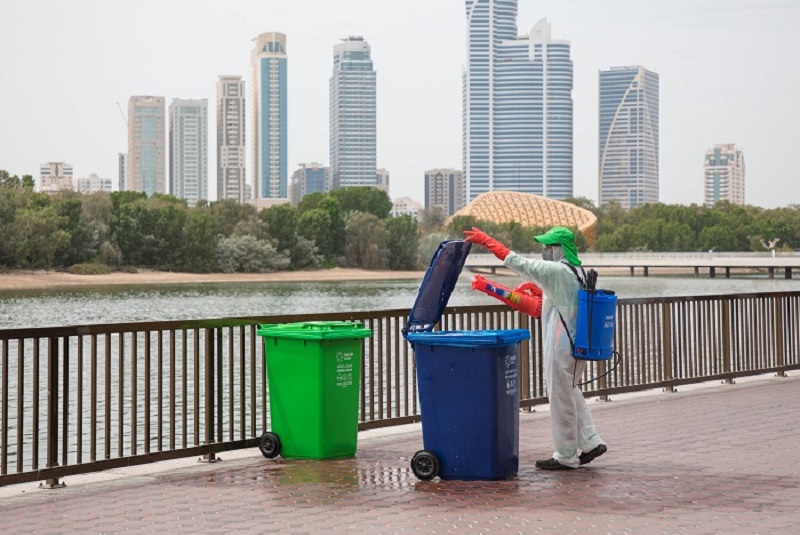
The company also ramped up the frequency of disinfecting waste bins in high-traffic, high risk areas and started equipping city cleaners and vehicles with PPE, sanitisers, etc. “We carried our disinfection of our office and labour accommodation to protect our people. Also considering the demand for such services, we launched a specialist disinfection and sanitisation service for private and government entities,” he stated. Bee’ah has been providing disinfection services for all government offices in Sharjah since the campaign started, having covered more than 200 buildings till date. The disinfectants used for indoor and outdoor spraying are made from natural elements and do not contain chemicals, he said.
 Khamees Al-Siyabi, Head of Department-MSW Operations at be’ah, Oman, gave an overview of the waste management operations, related issues and how be’ah was dealing with them during the crisis. While be’ah is the entity responsible for solid waste management in Oman since 2009, the outdoor cleaning functions still remain with the municipalities, said Al-Siyabi. The entity deals with both municipal solid waste and industrial waste, with healthcare waste falling under the latter category. Their strategy has been to outsource waste management services having divided the country into different segments and awarding 11 contracts to cover MSW operations in the country till date. He said, “We now serve almost 93% of the population, with a small portion still being taken care of by the municipalities. By the end of this quarter be’ah with be covering the waste management operations in the whole country through the contracts we are awarding to different companies.”
With regard to Covid-19, he said Oman is still in the early stages as compared to other countries. “The spread of the virus has been flat and under control so far. As of 14 May about 4000+ cases have been reported and there are a high number of cases that have recovered as well. However, the picture is changing rapidly as the number has been increasing over the last few days.”
The government has taken various measures similar to other countries including: cancellation of international flights, 14-day quarantine for arriving passengers; closure of schools, most shops and malls; closure of public offices except for those providing essential services; reduced staffing; work from home promoted as a norm; lockdown in certain areas with recorded high cases or social transmission, among others.
Equipment and technology
DM has ensured the equipment they use are up-todate, said Dr. Naseem. They had deployed 4 drones for disinfecting certain areas that were not easily accessible by other vehicles; small vehicles were used to disinfect some areas, especially narrow and difficult to reach areas like pavements; and modern equipment and vehicles were deployed for high pressure spraying as part of the street disinfection process, including 13 logistics support vehicles and 25 spraying vehicles.
There was a need to upgrade their fleet considering the unique situation and requirements for mass disinfection, said Sanjurjo. “While we were reusing and customising some of the vehicles, Bee’ah also acquired new equipment to handle the specialised services including spray cannons. So, our team was ready to deal with the situation even before the lockdown started in March.” Their sanitisation team uses a monitoring system that collects, analyses and reports data from a variety of quality tests, providing accurate sanitation verification data to the client.
Bee’ah also launched Disinfection Pods that were first installed at their facilities. “Later there was a demand for this device from our close partners and we saw a business opportunity to offer this solution to our clients, who could install these devices at their facilities to safeguard the health of their people,” he commented. The pods can be placed at the entrance of facilities, complexes, buildings or high-risk areas to eradicate viruses, bacteria and other microorganisms on a person or their clothing.

Strategy and response to current challenges
The safety department has been working closely with the national and local crisis teams, “and we were among those that decided to close the Naif area to contain the spread of the virus to ensure sterilisation was happening 24 hours for 26 days continuously, also ensuring that all the vehicles and equipment entering the area were disinfected,” Dr. Naseem explained, adding that the campaign was successful.
DM has also been collaborating with strategic partners like DHA, Dubai police, ambulance, civil defence and many other entities. “We work together as per our action plan to make sure all the KPIs we have are achieved in an efficient manner,” she stated. The municipality participates with the Command and Control Centre as well, and has a surveillance system to monitor the infected cases, contacts, etc., to take action for deep cleaning and disinfection process. “We have active monitoring of various areas and every evening we have routine meetings with the higher committee and crisis team where we update them regarding the inspections at facilities including construction sites, labour accommodation, laundries, etc. We made numerous visits and in case they were not complying with the rules, we took necessary action.”
As part of the waste management programme, DM has treated more than 350 tons of medical waste resulting from examinations and remedial interventions (Covid-19) in the emirate, noted Dr. Naseem. “The operations are in line with the best environmental practices worldwide and the medical waste is treated by Dubai Municipality at the Jebel Ali treatment site. All equipment, vehicles and areas are completely sterilised to avoid any kind of contamination.”
There are challenges, but the operations have to continue as this is an essential service, said Al- Siyabi. “The bigger worry when you are running such an operation is regarding the safety of our workers, and whether they could possibly get infected with the movement of the trucks and the crew entering quarantined or other restricted areas. We do offer our services in a normal manner, but also applying necessary controls considering the situation,” he commented, also highlighting the system where their monitoring officers across the country still continue their work either remotely from home or from the project areas.
Local authorities have been conducting disinfection campaigns across public areas ensuring hygienic conditions and even though they have adopted a less comprehensive approach to the disinfection campaign, it is probably connected to the advice regarding the effectiveness of these disinfection measures in open areas, like areas that already have restrictions on the movement of people, plus there are other measures, said Al-Siyabi. He pointed out that “there is evidence to suggest that disinfection in open areas is probably not that effective even though precautionary measures are definitely positive. be’ah supports local authorities in their efforts by using their bin washing equipment for this purpose. We have the responsibility of washing the bins, so our equipment is fit for the purpose of disinfection when it comes to spraying, etc. and of course, the large fleet that we have in the country as well.”

Health & Safety
DM has been regularly conducting joint inspections of labour accommodations, construction sites, salons, shopping malls, commercial centers, markets laundries, consumer products, food establishments to ensure that all the safety measures they have taken are fulfilled, said Dr. Naseem. The vehicles and equipment used for cleaning and sanitisation are disinfected and all necessary measures are in place to ensure staff and worker safety, she noted.
All three entities have taken steps to ensure the workers practice social distancing, also ensuring there is no contact between the staff when they change shifts to avoid cross contamination or infection. The workers are also disinfected after each shift to reduce the risk. be’ah has also advised service providers to ensure vehicles are disinfected at the end of each shift and they have provided quarantine areas for all service providers, with certain procedures to be adopted for suspected cases or those identified with symptoms, Al-Siyabi said. “We have intensive campaigns for washing and disinfecting the bins with different types of bin washing equipment. Our main focus has been on the cities as they are densely populated.” There is an added health risk to their operations as they collect and treat increasing quantities of healthcare waste across the country, he stressed.
One essential part is that of service providers providing appropriate Personal Protective Equipment: masks, gloves, full body suits etc. to all personnel, especially the frontline workers. “I think the bigger challenge is in ensuring the workers comply with the rules. Sometimes it involves long hours of work and the equipment might be inconvenient, so they tend to be relaxed about these measures. One of the issues our service providers have been facing is how to encourage the workers to keep their protective equipment on while providing the service,” he said.
At Bee’ah, employee safety is their foremost priority, said Sanjurjo. All vehicles and assets are sanitised daily, and all common touchpoints cleaned with alcoholbased disinfectants. They have implemented health and temperature checks for all staff and workers entering or exiting all the facilities including workers’ accommodation areas. The company has also installed thermal scanners at their head office.
All three organisations have effective communication plans and measures in place to educate the frontline workers and the wider population. All their workers have undergone hygiene and sanitisation training, and the entities have also been promoting via social media channels safety measures for the general public including awareness messages to stay safe.
In Oman, be’ah has asked the service providers to take certain measures to decongest and ensure they minimise the number of workers in accommodations, and also encouraged them to have more resources in place in case they need more manpower, said Al-Siyabi.
Dr. Naseem stated: “We have issued certain circulars and technical guidelines regarding various processes. This also includes guidelines for the residents, so they know the procedures regarding cleaning and disinfection, social distancing, use of approved products and so on.” Sanjurjo said, Bee’ah’s HSSE team had formed WhatsApp groups to create awareness on various issues among workers, with messages being communicated in different languages.
This webinar was held on May 18 as part of Waste & Recycling MEA Virtual Forum – an exclusive webinar series from May-July featuring a range of industry experts.
Suez Middle East Recycling at the Forefront in the Fight Against COVID-19
In the frontline during Covid-19 crisis, Suez Middle East Recycling LLC (SMER) has shown great resilience and agility to deliver essential waste management services while maintaining high safety standards. SMER is a local subsidiary of the French-based global group SUEZ and has been operating in the waste management industry in the United Arab Emirates since 1977. The company combines global knowledge, with firm roots in local communities, to shape the future of waste recovery in the UAE.

Waste management being a key element of the ‘essential services’ industry, SMER’s main priority was to ensure service continuity while maintaining the safety of its customers, partners and employees. Leveraging best practices from their global operations and keeping abreast with directives from the federal government and local authorities, SMER was able to implement various measures to ensure that essential services are provided without interruptions and with all the required safety precautions.
Keeping in mind the safety of its on-ground personnel and clients, safe operating procedures have been developed and implemented throughout their operations to prevent exposure and transmission of COVID-19. Special measures have also been put in place to guarantee situational readiness of key equipment. SMER’s vehicles are thoroughly sanitized before use with special attention paid to disinfection of the medical waste fleet. Their well-trained collection team is also ensuring that each bin and skip are disinfected after every collection.
A very proactive decision was taken to segregate their on-ground personnel in two separate staff accommodations to limit physical interactions. Regular disinfection is carried out within the staff accommodations and temperature checkpoints are installed and enforced upon entering the premises. Sanitization stations are set up in various parts of the premises, use of masks and gloves are deemed mandatory and an adequate amount of such Personal Protective Equipment (PPE) is provided to ensure full compliance.
A customized training and awareness program was rolled out to empower the staff to cope with the evolving situation. Training sessions are conducted by the HSE team highlighting proper use of PPE, social distancing rules, COVID-19 symptom awareness and various Standard Operating Procedures (SOPs). With over 40 years’ experience in the region in the field of medical and bio-hazardous waste management, SMER has been at the forefront in the fight against COVID-19. As a market leader in medical waste management, SMER’s expert teams have been providing specialized COVID-19 waste management services to its clients in the medical industry to prevent any contamination from any suspected or confirmed COVID-19 waste.

In accordance with Dubai Municipality’s standard, COVID-19 waste is segregated at the client’s facility and collected using the highest standard PPE. The waste and waste containers are diligently disinfected during the collection and the waste safely transported to the approved treatment facility. In addition, continuous awareness sessions are conducted with our clients to ensure COVID-19 waste is managed in a safe and compliant manner to minimise risk of contamination.
According to Dubai Municipality regulation, SMER has been making its clients aware of safe disposal techniques and procedures for used PPE waste, classified as medical waste. A dedicated team and respective procedures have been put in place to ensure their clients have the appropriate medical waste containers and the storage and collection is completed as per the established medical waste protocol. SMER’s experience in medical waste management enables them to support this initiative and prevent any contamination.
Maintaining a strong Health and Safety (HSE) culture and to contribute to the wellbeing of their clients and partners, Suez Middle East Recycling has launched a Disinfection service to provide safe and effective disinfection services. Disinfection is conducted using state of the art fogging and misting applications and is suitable for open and confined environment. Special care has been taken to ensure that the products used kill 99.995% of bacteria and viruses and at the same time are nontoxic, hypoallergenic and non-irritant. Service standard and the SOPs are fully aligned with WHO and Dubai Municipality Standards.
SMER also depends on the in-house specialized Emergency Response Team to manage and mitigate any incidents that may occur in the current challenging environment. Andre-Louis Brenier, General Manager of Suez Middle East Recycling, shares, “We take great pride in extensively contributing to the fight against COVID-19.
We are thankful to our team who have shown great resilience and adaptability in this challenging time which did not impact the quality and reliability of our service. It is a testament to the agility and adaptability of our team who is also deeply committed to introduce innovative and smart treatment solutions to the market to contribute to United Arab Emirates’ sustainability targets.”